Amazon’s New AI-Generated Person Image Rules Are Here—Can Your Listing Images Pass Inspection?

After August 15, image compliance gets stricter
On August 15, 2026, Amazon’s new rules officially took effect: sellers must proactively disclose in Seller Central any AI-generated or AI-assisted assets used in Listing images, A+ Content, or Brand Stores. The change follows New York State’s Synthetic Performer Disclosure Law, which took effect on June 9, and Article 50 of the EU Artificial Intelligence Act, which officially became applicable on August 2. With regulators tightening requirements almost simultaneously, Amazon chose to turn disclosure into a standardized checkbox process across all marketplaces.
Under the current enforcement approach, realistic AI-generated people appearing anywhere in an image fall within the disclosure scope—even a hand wearing a ring or an arm displaying the effects of a skincare product. A complete face is not the only criterion. Failure to disclose can result in a fine of up to $1,000 for the first violation and up to $5,000 for each subsequent violation, with penalties accumulating by violation count.
For many sellers, the first reaction to the new rule is not “Do I need to disclose this?” but “I have no idea which images qualify.” Following the rule further reveals that image production has never been particularly simple.
Unclear classifications: Which images need disclosure?

A designer opens last month’s batch of A+ Content assets one by one, trying to decide: Is the model in this lifestyle image a realistic AI-generated person? Does it require disclosure? What about the image beside it, which shows only an arm displaying a necklace—does that count as a “body part”? When the designer opens Seller Central to apply labels consistently, they discover that the source files for images generated six months ago are long gone. They cannot even confirm whether a particular image was originally created with AI.
Dimensions do not match, and every revision creates new problems
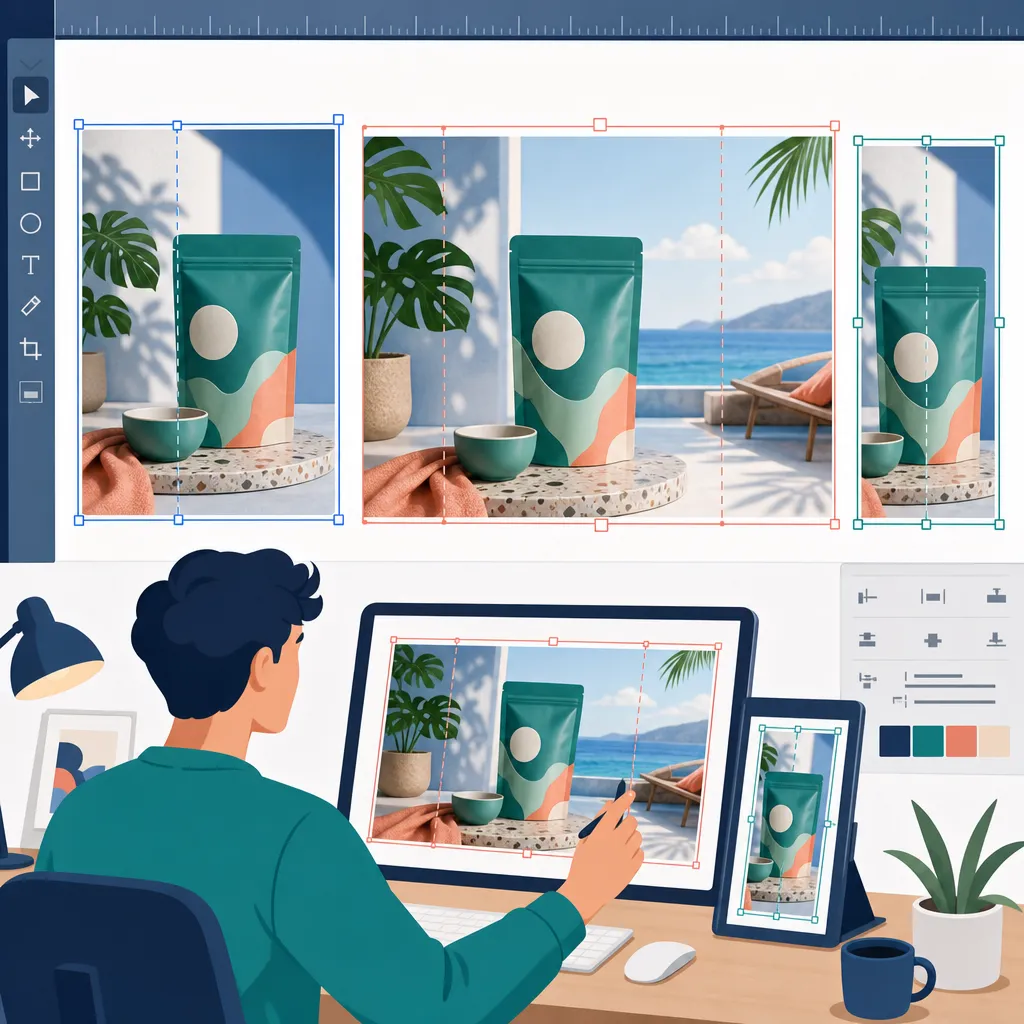
Amazon has specific image requirements for A+ Content: standard A+ requires 970×600, Premium A+ requires 1464×600, and mobile requires a separate 600×450 format. A designer may fix the dimensions in one revision only to disrupt the composition. Once the composition is corrected, the image has to be cropped again.
Too few lifestyle images to fill the secondary slots

After finally gathering a few acceptable lifestyle images for the secondary slots, the seller still may not have enough. Buyers need to understand a product from different angles and in different use scenarios, but the available assets often come down to the same two or three images.
You already have a long image, but adapting it for every channel means starting over
Some sellers avoid AI-generated images altogether. They created a complete product infographic several years ago, covering everything from selling points to detailed views. However, each channel has different image-size requirements. Adapting that infographic to Amazon’s specifications means cutting it apart from scratch again, which takes time and strains the eyes.
These issues look different when viewed separately, but together they point to the same problem: producing, revising, and keeping image assets compliant now requires more effort to align with the rules than before.
Handle all of these tasks in one workflow
We created the Listing AI extension to connect these steps in one workflow. Images generated with it—whether lifestyle images or A+ Content assets—already meet the standard A+ 970×600, Premium A+ 1464×600, and mobile 600×450 requirements, so you do not need to crop and assemble them manually. When creating lifestyle images, the tool generates several complementary scenarios at once, making it easier to select multiple scenes for use as secondary images instead of generating and collecting them one by one. If a generated image has an unsatisfactory detail, such as an unnatural hand pose or lighting flaw, you can refine that area directly until it looks right without rebuilding the entire image. If the image contains an AI-generated person, you can also choose whether to add the AI person disclosure.
For the compliance requirements mentioned above, sellers who already have long infographics and do not plan to create more AI-generated images can use the A+ Image Splitter to divide existing long images into assets that meet each channel’s size requirements, without redesigning them from scratch.
During this early stage after the new rule took effect, there is still no fully standardized answer to how much disclosure is enough for compliance. Amazon’s own announcement does not specify the exact disclosure format or layout in much detail, so the practical standard will depend on subsequent enforcement. Image dimensions and the number of available lifestyle images, however, can at least be organized in advance.
Note: The Amazon AI asset disclosure policy, New York State’s Synthetic Performer Disclosure Law, and the effective date of Article 50 of the EU Artificial Intelligence Act mentioned in this article are based on publicly reported information from 2026. For detailed implementation requirements, refer to the latest announcement in Amazon Seller Central.