Platform AI Is Getting More Capable. What Are Multichannel Sellers Still Missing?

On this page
Three Platforms Talked About Their Own AI on the Same Day
On October 28, 2026, Shopify released its Fall '26 Edition, while eBay and Etsy announced their third-quarter financial results on the same day. AI was one of the main topics in all three materials: Shopify rebuilt Sidekick, eBay expanded Magical Listing to six major sites, and Etsy mentioned an AI seller assistant currently in beta testing.
If you sell on only one platform, this is good news: the platform's own AI understands your store better and better. But if you sell across Amazon, eBay, Walmart, and TikTok Shop at the same time, you may run into a problem: each platform's AI only manages its own corner of the business.
What the Three Platforms' AI Tools Do

Shopify Sidekick: An increasingly hands-on store assistant. The Fall '26 Edition announced more than 150 updates. After its rebuild, Sidekick can handle multistep technical operations, remember context, and test suggestions before you accept them. Canvas, launched on October 1, lets merchants build and edit store pages by chatting with Sidekick.
eBay Magical Listing: Faster listing creation. In its earnings report, eBay said the latest version of Magical Listing now covers all new and returning sellers in the United States, United Kingdom, Germany, Australia, France, and Italy. It uses AI to generate product descriptions, categories, and attributes, while also offering pricing suggestions. Management gave Australia as an example: active sellers listed about one-third more items per listing attempt, while listing time fell by about one-third.
Etsy AI Seller Assistant: Business advice, still in beta. During Etsy's earnings call, its CEO said the assistant provides personalized insights based on each shop's own data and recommends what to focus on next. That same week, Etsy also tightened its AI product policies, including a requirement that most products have at least one unedited real-life product photo.
The three tools take different approaches, but they share one trait: they all live inside their respective platforms and can only see data from their own platforms.
A Monday Morning for a Multichannel Seller

At 9 a.m., you open the Amazon Seller Central dashboard first. There are three buyer messages: one asks about shipping, and another has already raised an A-to-Z claim. Next, you switch to eBay, where a buyer in Germany wants to know whether a return is possible. Then you move to Walmart, where one message is nearing its response deadline. TikTok Shop has two more unread messages. By the time you finish checking all six dashboards, the earliest message has already been waiting for more than an hour.
The rules also differ from platform to platform. For the same pair of headphones, Amazon may require key specifications within the first 80 characters and prohibit repetitive keywords. Walmart and eBay use different character limits and writing conventions. Each platform's built-in AI can revise the title according to its own rules, but it will not tell you that the title for the same SKU on another platform has not been updated in two years.
Even the smartest platform AI cannot solve the need to switch between six dashboards. That is not because any one AI is poorly designed; these tools were simply not built for cross-platform work.
Separate On-Platform Work from Cross-Platform Work
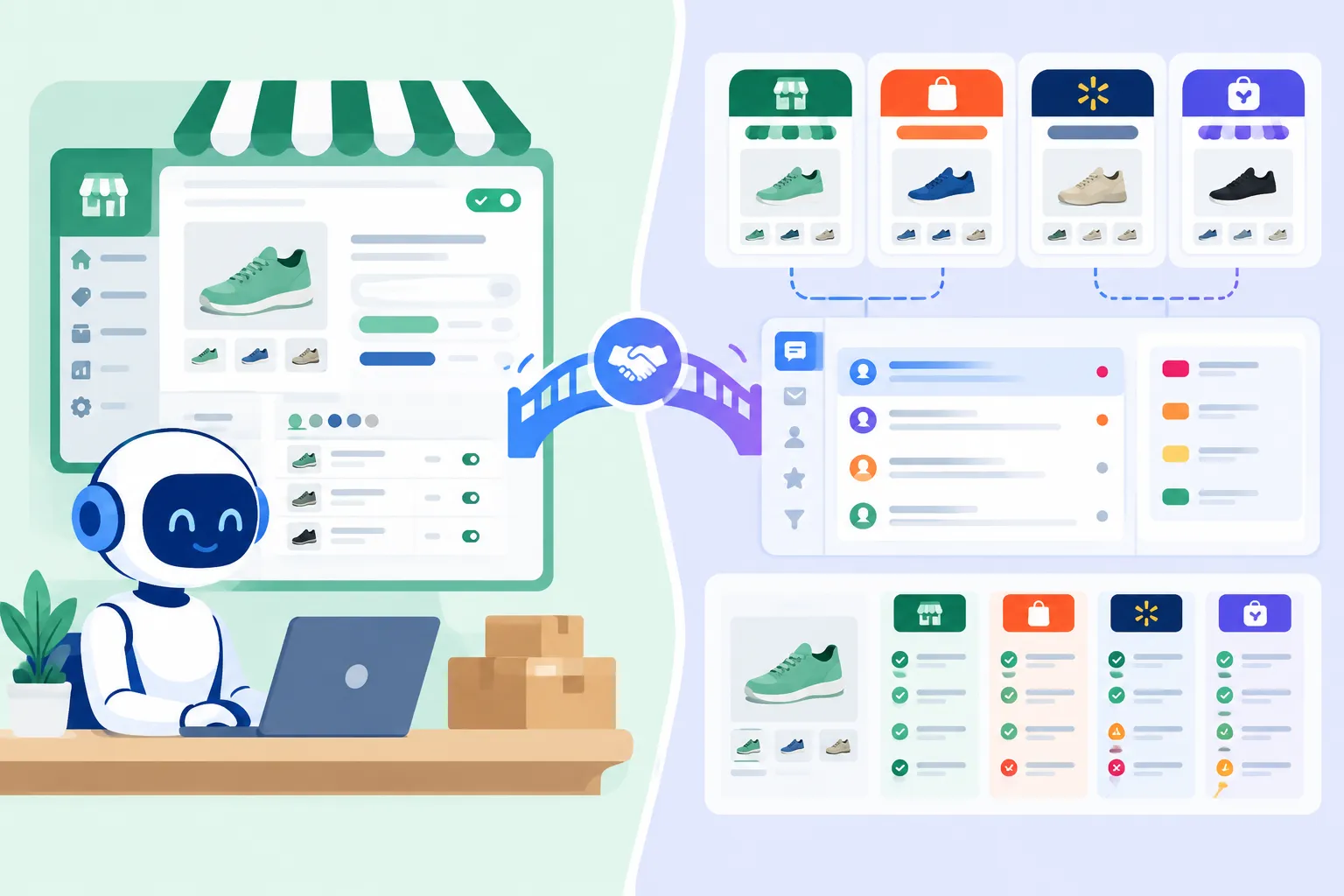
A practical approach is to divide AI tools into two layers instead of choosing only one.
- Give platform-specific tasks to platform AI. Use Shopify to build store pages, eBay to list secondhand goods quickly, and Etsy to review business recommendations for your own shop. Native platform AI is closest to the relevant data and is often the easiest to use.
- Use a workspace that can see multiple stores for cross-platform tasks. For example, it can queue all buyer messages in one inbox by urgency and inspect the Listing for the same product on different platforms according to each platform's rules.
To decide whether you need the second layer, ask yourself two questions: How many seller dashboards do you log into every day to answer messages? When was the last time you updated the title for the same SKU across every platform? If the answers are “more than three” and “I can't remember,” the second layer may be worth considering.
A Quick Comparison of Responsibilities
Native platform AI is good at “going deeper within one platform,” while a cross-platform workspace fills the gap of “connecting several platforms.” They are generally complementary.
| Shopify Sidekick | eBay Magical Listing | Etsy AI Seller Assistant | Cross-platform workspace (example below) | |
|---|---|---|---|---|
| Primary use | Execute store operations in the dashboard, edit themes, and build workflows | Use AI to generate descriptions, categories, attributes, and pricing suggestions to speed up listing | Provide business insights and next-step recommendations based on shop data | Handle buyer messages across platforms and diagnose Listings across platforms |
| Data it can see | This Shopify store | This eBay account | This Etsy shop | Multiple connected platform stores and email accounts |
| Buyer messages | Not its primary focus | Not covered | Not covered | Six platforms + 10+ email accounts in one inbox |
| Listing optimization | Can edit store content and images | Automatically generates content during listing | Not highlighted as a key feature | Diagnose each field according to platform rules and change only selected items |
| Current status | Available, included with Shopify plans | Available to new and returning sellers across six sites | In beta testing | Available; Shopify listed as in development, Etsy not currently supported |
Scope note: Information about the platform AI tools in this table comes from official announcements and earnings materials published around October 28, 2026. The exact feature scope depends on each platform's dashboard.
How We Solved This Ourselves
Niceggie's own multichannel customer service team encountered the same problem of switching back and forth between dashboards. We later organized our internal approach into Niceggie, which focuses on two main tasks.
One unified customer service inbox. Buyer messages from Newegg, Amazon, Walmart, eBay, Best Buy, and TikTok Shop, along with 10+ email accounts such as Gmail, Outlook, and QQ Mail, enter the same workspace. AI first reads the order and shipping status, assesses the buyer's sentiment, and drafts a reply. The message is sent only after you confirm it. Urgent disputes such as A-to-Z claims are moved to the front of the queue. If a buyer in Germany writes in German, the reply is drafted in German with a Chinese translation below it. You can also set common questions as automated reply rules, such as enabling them only on weekends.
Cross-platform Listing diagnostics. Open a product page on Newegg, Amazon, eBay, Walmart, Mercado, or TikTok Shop, and the Chrome extension checks the title, bullet points, details, and consistency item by item against that platform's rules. It explains each issue and why it matters. The AI changes only the items you select and leaves everything else as it is. Diagnostics do not require a connected store or a password.
One limitation is important to mention: Shopify support is still in development, and you can join the waitlist on the website. Etsy is not currently supported. If you sell only on Shopify or Etsy, the platform's built-in AI may be enough.
The Practical Takeaway
Platform AI will keep getting stronger, which is good news for every seller. But the more platforms you use, the more useful it becomes to have one place that brings them together. Whatever tool you choose, start by making two things visible: how many messages still need a reply today, and which platform Listings have not been updated. If you want to see the interface first, the AI Customer Service page includes an interactive demo powered by sample data.
Sources
- eBay Q3 2026 earnings release (SEC 8-K exhibit): Magical Listing coverage across six sites
- eBay Q3 2026 earnings call transcript (Benzinga): Australia listing data and pricing suggestions
- Etsy Q3 2026 shareholder letter (SEC)
- Etsy Q3 2026 earnings call transcript (The Motley Fool): AI Seller Assistant in beta
- Shopify Fall '26 Edition explained (witscode): Release date and Sidekick rebuild
- TechCrunch: Shopify launches Canvas
- Niceggie AI Customer Service product page, Listing AI product page: Supported platforms and features